Introduction
Scholarship has become the space in which I intentionally integrate theory, research, and practice to better understand and improve learning in complex, technology-rich environments. My evolving research agenda centers on the intersection of emerging technologies, adult learning experience design, and workforce and organizational development. This agenda reflects a commitment to bridging theory and practice, using scholarly inquiry to inform real-world learning challenges while contributing to ongoing conversations in instructional systems design and technology.
My approach to scholarship is grounded in interdisciplinary collaboration and applied inquiry. I view research as a process of connecting diverse perspectives from researchers, industry partners, and practitioners to co-construct knowledge that is both theoretically informed and practically meaningful. This orientation is guided by principles of collaboration, practical relevance, and continuous improvement through iterative, data-informed processes. These principles shape not only the problems I investigate but also how I design studies, interpret findings, and share knowledge with professional communities.
Today, I am still developing my scholarship in important ways. I am working to strengthen the depth of my theoretical integration, broaden my engagement with peer-reviewed research, and expand my methodological repertoire to include more advanced and scalable research designs. Developing these areas will allow me to move beyond individual studies toward a more sustained and theoretically cohesive research program. I plan to pursue this growth through continued engagement with the scholarly literature, collaboration with experienced researchers, and the intentional refinement of research designs and analytic approaches in future work.
Together, these efforts position scholarship as an evolving and integrative component of my professional identity. As I continue developing as a scholar-practitioner, my goal is to produce research that informs my learning design and service work while also contributing to broader conversations about how learning systems can adapt and thrive within rapidly changing technological and workforce contexts.
Primary Evidence
To advance this research agenda, I have been developing competencies in critical literature synthesis, research design, quantitative inquiry, data-informed analysis, and scholarly communication throughout my doctoral program. These competencies are reflected across the primary evidence presented in this section, particularly in my literature reviews, research manuscript, and scholarly presentation. My literature reviews demonstrate an emerging ability to analyze and compare instructional design theories and practices, while my research manuscript illustrates growth in structuring research questions, applying appropriate methods, and interpreting findings. My scholarly presentation reflects my capacity to translate research-informed insights for professional audiences. Collectively, these artifacts represent a trajectory of increasing rigor and clarity in how I frame, conduct, and communicate scholarship.
A Review and Comparison of the SAM and Dick and Carey Instructional Design Models
Literature Review Instructional DesignA recent review of literature and exploration of two popular instructional design models.
View Evidence
Defining and Labeling the Field of Instructional Design: A Perspective and Position
Literature Review Instructional DesignA review of recent literature surrounding the definition of the instructional systems design and technology field.
View Evidence
Final Grade Outcomes and LMS Student Engagement
Research Paper Learning AnalyticsAn exploratory quantitative analysis into the association between engagement within an LMS and students' final grade outcomes.
View Evidence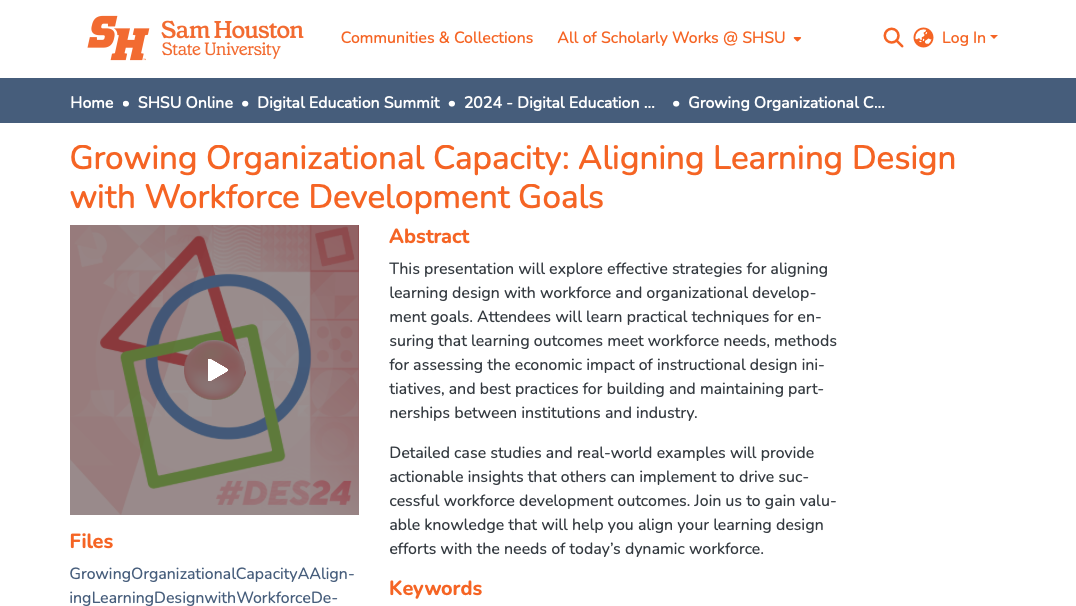
Growing Organizational Capacity: Aligning Learning Design with Workforce Development Goals
Conference Presentation Data-Informed Instructional DesignA conference presentation at the 2024 Digital Education Summit conference that explores effective strategies for aligning learning design with workforce development goals.
View EvidenceSupplementary Evidence
My supplementary evidence for competency in scholarship demonstrates additional growth in producing professional reports and co-writing grant projects which surround the integration of adult learning, workforce development, and educational technologies.
Building Better Jobs in Texas: Transforming A Regional Workforce Training System...
Grant Proposal Submitted, RejectedCo-PI, $10.6 Million U.S. Economic Development Administration Good Jobs Challenge grant proposal to design, develop, and implement...
View Evidence
Texas State University System Online Education Annual Report, Sixth Edition, November 2022
Publication Annual ReportReport co-author, contributed scholarship in alternative credentials, learning technology innovation, and report data visualization.
View Evidence
Sam Houston State University Online Continuing Education Report, Fiscal Year 2023
White Paper PresentationPresentation author, analyzed and reported on affiliated continuing education partnerships, their enrollment data, and online course...
View Evidence